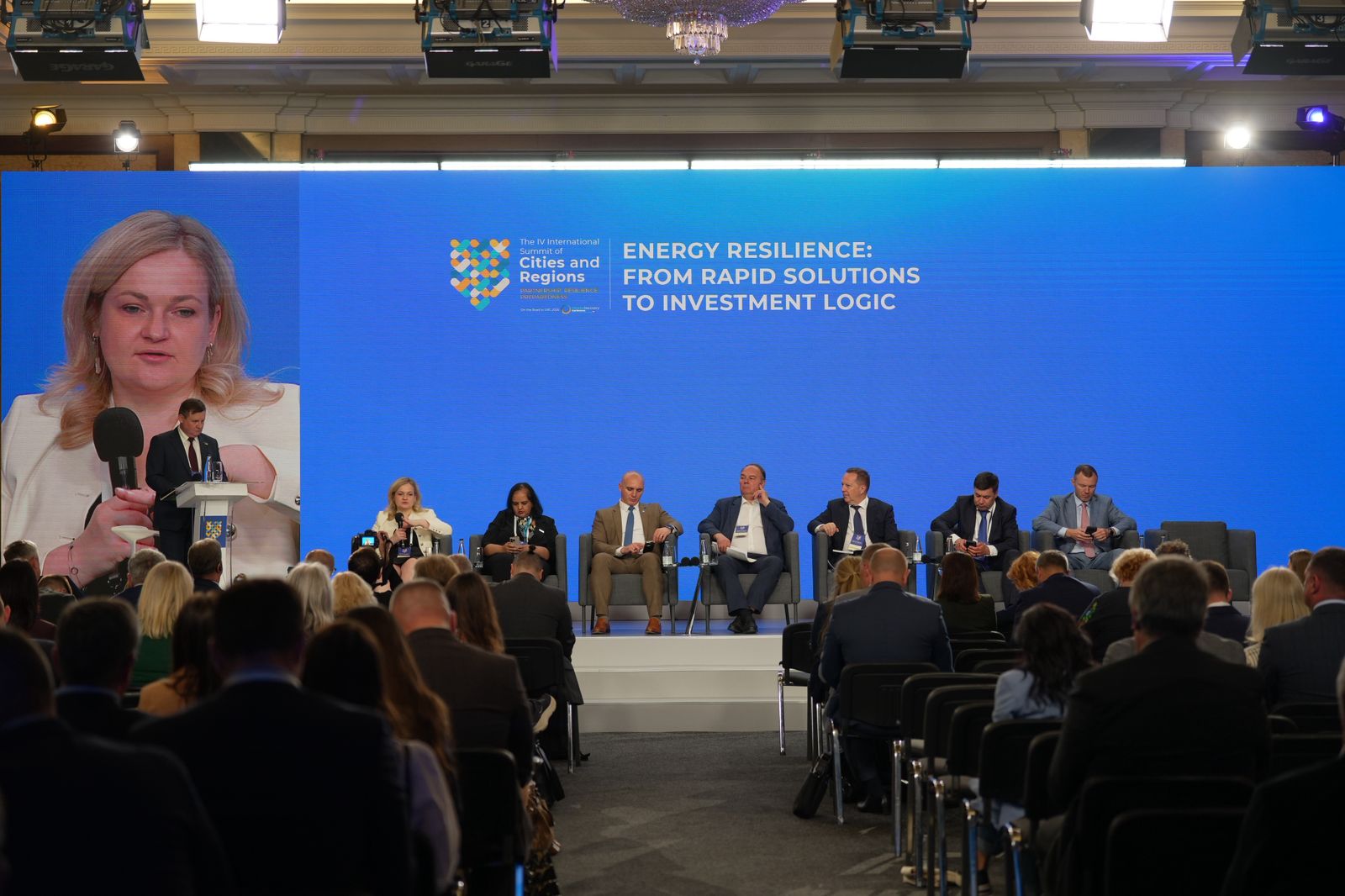
Deputy Minister of Energy of Ukraine Valentyna Moskalenko took part in the panel discussion “Energy Resilience: From Rapid Solutions to Investment Logic”, held during the International Summit of Cities and Regions within the framework of the Congress of Local and Regional Authorities under the President of Ukraine.
During the discussion, participants addressed issues related to strengthening community energy resilience, developing distributed generation, restoring damaged energy infrastructure, and attracting investment into energy security projects.
Valentyna Moskalenko stressed that community energy resilience today is based on three key components: protection of energy infrastructure, restoration of damaged facilities, and development of new generation capacity.
“At the national level, the Ministry of Energy is working to strengthen the protection of energy infrastructure facilities, electricity transmission systems, as well as natural gas production and transportation infrastructure. At the same time, extensive efforts are underway to restore damaged capacity and develop new generation facilities,” the Deputy Minister stated.
She noted that Ukraine plans to restore approximately 5.8 GW of generation capacity by the end of the year. The works are being carried out by both state-owned and private energy companies with the support of international partners. In particular, more than EUR 300 million has been mobilized this year alone through the Ukraine Energy Support Fund to support the recovery of the energy sector.
Valentyna Moskalenko also focused on the development of distributed generation and new mechanisms to stimulate the construction of generation facilities.
“We have already implemented around 1.5 GW of distributed generation capacity. In addition, a tender is currently underway for the construction of 1.322 GW of new generation capacity in energy-deficient regions,” the Deputy Minister noted.
According to the Deputy Minister, it is important for communities to develop their own approaches to energy resilience, strengthen cooperation with businesses, introduce energy storage systems, and assess the economic efficiency of energy projects.
Participants in the discussion also addressed the role of local self-government, businesses, and international partners in strengthening community resilience, creating new investment opportunities, and implementing modern energy solutions.